

Donating scarves and turbans for Pink October: which scarf to donate and how to help
October is here, and with it breast cancer prevention campaigns gain momentum. Read Scarf Me's article on scarf donation initiatives.
October is here, and with it breast cancer prevention campaigns gain momentum. Read Scarf Me's article on scarf donation initiatives.
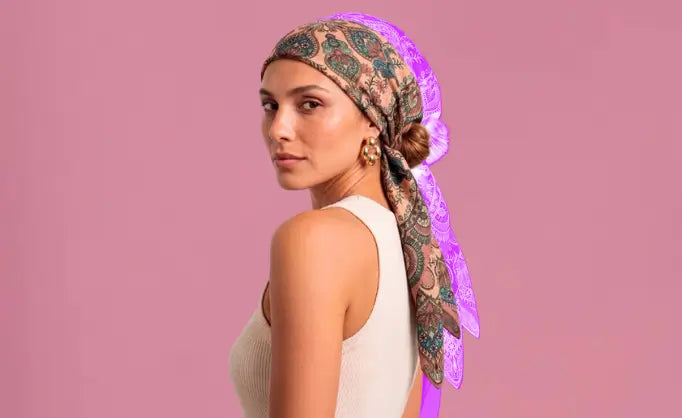
To donate scarves to cancer patients, choose square scarves of at least 90x90cm or turbans, in a light, soft fabric such as cotton or silk, new or in excellent condition. It may seem like a detail, but it is what separates a scarf worn every day from one that stays in the drawer.
Pink October exists to raise awareness of the importance of early breast cancer detection. Brazil's National Cancer Institute (INCA) estimates 78,610 new cases a year in the country between 2026 and 2028, and breast cancer is the most common cancer among women, accounting for about 30% of diagnoses. For many of them, treatment includes chemotherapy, and with it, hair loss.

Losing their hair is among the greatest fears of women undergoing cancer treatment. A scarf gives back a choice at a time when so much is out of their control: color, print, the way it is tied. It also protects the scalp, which is more exposed to sun and cold.
Donating is simpler than it seems. Organizations such as the Instituto Quimioterapia e Beleza (IQeB) accept scarf and hair donations. And small groups make a difference: in October 2014, a drive at the UNINTER university center collected around 90 scarves, delivered to women in treatment at the Hospital de Clínicas in Curitiba.

A ready-to-wear turban already comes shaped to the head: just put it on, with no knot and no practice. On the more tiring days, common during treatment, that makes a difference, and for anyone who has never tied a scarf it is the simplest route. In 2018, at a turban workshop held by the Fundo Social de Solidariedade in Jundiaí (São Paulo state), the daughter of a patient said she had bought scarves to support her mother but could not manage the ties.
The scarf wins on versatility. The tie changes with the day and, after treatment, it stays in the wardrobe, around the neck or on a bag.
That is why many campaigns accept both. In October 2024, the Rio de Janeiro Court of Justice set up a collection point for scarves, turbans and hair, bound for organizations that support women with breast cancer. A complete donation can combine a turban for everyday wear and a 90x90cm scarf for variety.
Scarf Me offers seven ready-to-wear turban styles, in one size, most in shades of pink, with options in blue and one printed design. On the same page you will find the Refúgio Collection, created by the brand for Pink October 2024.
The founder of IQeB advises that donated scarves be at least 90x90cm, so they can cover the entire head. The math checks out: folded into a triangle, a 90x90cm scarf has a 127cm diagonal, enough to wrap around the head and still tie a knot. A 110x110cm scarf gives more volume and more tying options.
Bandanas of 65x65cm and smaller scarves work as headbands but do not cover the whole head. Pashminas and long scarves are not the best choice either, because they are pieces designed for the neck and shoulders.
The scalp can become sensitive during treatment, and the scarf will spend hours in contact with it. Cotton breathes, slips less and holds up to frequent washing, which makes it the most practical choice for everyday wear. Silk is soft and cool, but it slips more on a head without hair; a thin cotton cap underneath solves that. Polyester works, but it feels warmer on hot days.
Avoid thick or rough fabrics, metallic threads, embroidery and embellishments on the part that touches the head. On a forum run by the British charity Breast Cancer Now, a patient shared that she had received many scarves but almost always wore the same one: the others were too thick or too big, made to accessorize an outfit rather than to cover the head. Her favorite had a neutral print that did not draw attention. Since tastes vary, it is worth donating a mix of understated neutrals and more cheerful prints.
New or in excellent condition, washed, free of stains, pulled threads or perfume. During treatment, the sense of smell can become more sensitive, and a fragrance you find pleasant may bother the person who receives it.
Call the organization first and confirm what it accepts: scarves, turbans or both, size, fabric, whether it takes used pieces and on which days to drop them off.
Wash and iron each scarf, or keep it in its original packaging if it is new.
Fold and pack each piece separately, in a clean bag.
Include a note with a simple tie, drawn or printed. Anyone who has never worn a scarf will appreciate the step-by-step, and the how to wear a scarf page from Scarf Me can serve as a guide.
Many hospitals and cancer centers accept donations, usually through their patient-care (humanization) or volunteer departments. Nonprofits that support cancer patients, such as IQeB, accept them too. If you are thinking of donating hair, IQeB asks for locks of at least 20cm, delivered dry.
Companies can organize an internal drive during the month. At Hospital do Bem, in Patos (Paraíba), employees spent an entire workday wearing scarves on their heads, in an initiative to build empathy and fight prejudice against those who lose their hair during chemotherapy.
If you are buying to donate, the ready-to-wear turbans cover everyday wear with no tying, and the 90x90 scarves and the 110x110cm cotton bandanas meet the size that organizations ask for.
If the person in treatment is someone close to you, a scarf chosen for her means more than a generic donation. The post on the ideal scarf for chemotherapy can help with that choice. Pink October is also a good time to remind the women around you to talk to their doctor about routine screenings, and the post self-exam in 3 steps is a place to start.
Both help. A ready-to-wear turban needs no tying and makes the more tiring days easier. A scarf is more versatile and stays useful after treatment. A good donation includes one of each.
At least 90x90cm, a size that covers the whole head and still leaves fabric for the knot. Scarves of 110x110cm also work well and allow fuller ties.
Cotton and silk, because they are light, soft and breathable. Cotton slips less and holds up to more washing; silk is cooler, but it may call for a thin cap underneath.
Many organizations accept them, as long as the piece is in excellent condition, washed and free of perfume. Some only accept new pieces, so it is worth checking before dropping them off.
At hospitals and cancer centers, through their patient-care or volunteer departments, and at nonprofits that support patients, such as Instituto Quimioterapia e Beleza. Call ahead to confirm what each one accepts.
Small 65x65cm bandanas do not cover the whole head. For donations, choose square scarves of 90x90cm or larger, such as the 110x110cm cotton bandanas.
Select options